


Global Leader or Opportunistic Grifter? On India, Part 2
Ambiguous Ambiguity and Misaligned Non-Alignment
Continuing from Global Leader or Opportunistic Grifter? On India
So, working toward an answer re the title’s question…
As mentioned in Part 1, India’s turn toward Israel is just one factor that’s intensified criticism of New Delhi’s foreign policy stance, and, although India’s “non-alignment” doctrine appears to be the same one it’s embraced since its independence, due to current Power shifts, from a Global South and anti-colonialist perspective, India has clearly changed its stance, having taken a very “aligned” position.
Many factors substantiate that perspective and the deep frustration and disappointment felt.
And, while it’s absurd to think that the country’s ethno-nationalist ambitions are responsible for that change, this aspect is far more relevant than I may have let on in Part 1.
Further, we need to consider that it’s hard to pinpoint key policy changes without having access to a national foreign policy strategy document, which New Delhi hasn’t offered in quite some time. As such, without a firm framework that establishes clear moral boundaries as well as short- and long-term goals, it becomes real easy to define “best interest” purely on the basis of “trade deal” and to present strategic alliances as no more than nation-benefitting partnerships free of geopolitical implications.
However, if we assume that India’s non-alignment stance hasn’t changed—it’s only “perception” that’s changed—then, we must consider that India may have always been a very selfish and duplicitous country, and the current geopolitical situation is simply breaking the veil of shrewd neutrality it presented, revealing what has always been New Delhi’s morally-deficient, opportunistic ways, operating solely under a nationalistically egomaniacal “What’s in it for me?” mindset that wasn’t previously so apparent.
If this is so, we can also assume that the BJP’s “leader of the Global South” rhetoric has always been pure, manipulative BS.
At the “india” level, I don’t think that those two things are true, hence, I also believe that the “nation-benefiting trade deal” aspect alone doesn’t justify New Delhi’s decisions, as the “best interest” value of many of its recent moves certainly challenge, even contradict, that justification unless these were a part of a much broader, yet-to-be-articulated plan, one that would see India willingly aligning itself with the U.S.-led block.
I do believe that the latter is correct; the “willingness” part is what I wrestle with.
• • •
"Fundamentally, the problem of Palestine is a nationalist one. The Arabs are struggling against imperialist control and domination. It is a pity, therefore, that the Jews of Palestine, instead of aligning themselves with the struggle, have thought it fit to take the side of British imperialism and to seek its protection against the inhabitants of the country.”
~Jawaharlal Nehru, first Prime Minister of India
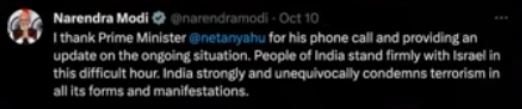
Here are just a few key events which illustrate India’s shifting attitude toward Israel.
- 1947 and 1949 - Newly independent India—built on anti-colonial solidarity—was one of only 13 countries to vote against the UN’s plan to partition Palestine (Resolution 181 (ii)).
- 1949 - India voted against UN Resolution 273, which granted the State of Israel membership in the United Nations
- 1962 - Indo-China war; Israel provided military support to India.
- 1965 - Indo-Pak war; Israel provided M-58 160-mm mortar ammunitions.
- 1971 - Israel provided military support to India during the third Indo-PAK war.
- 1974 - India voted in favour of Resolution 3236, becoming the first non-Arab country to "recognize the Palestinian people's right to self-determination and officialize UN contact with the Palestine Liberation Organization."
- 1975 - India signed UN resolution 3379 that "Determines that Zionism is a form of racism and racial discrimination."
- 1977 - Israeli Foreign Minister Moshe Dayan made secret visits to India to establish diplomatic ties.
- 1980 - IDF provides training to India Special Protection Group and National Security Guard.
- 1991 - India voted in favour of Resolution 46/86, which revoked Resolution 3379's designation of Zionism as a form of racism and racial discrimination.
- 1992 - Full diplomatic relations were established; India opened an embassy in Tel Aviv and Israel opened an embassy in New Delhi.
- 1999 - U.S. imposes sanctions on India following its nuclear weapons tests.
- 1999 - Kargil Conflict (Indo-Pak). Israel was the only nation to provide much needed military support (arms & tech) to India, doing so despite U.S. sanctions barring it from doing so.
- 2014 - Year Modi came into power; marks a clear shift in India's voting positions on UN resolutions relating to Israel. Since then, India's long-standing stance against Israel's actions in the region was no longer reflected, preferring to abstain whenever Israel was being condemned whilst supporting any resolutions made against Hamas.
- 2017 - Modi was the first Indian PM to visit Israel.
- 2021 - Creation of the I2U2 group, a strategic partnership between India, Israel, the United Arab Emirates, and the United States.
- From 2020 to 2024, India spent $20.5 billion on Israeli weapons, about 34% of its arms exports.
On 25-Feb-2026, The Jerusalem Post reported:
“Israel and India are set to sign historic defense deals worth up to $10 billion, strengthening military ties with agreements on missiles, drones, and AI as Indian PM Modi visits Jerusalem.”
In terms of "interests", consider that:
Beyond the “lost tribes” mythology, Iran is the country with which India shares rich historical and cultural ties and linguistic links (Avestan and Sanskrit), not Israel.
Iran is the country with tons of oil and other natural resources, not Israel.
Iran is a BRICS member, not Israel.
Advanced weaponry and tech, primarily, AI, cyber security, and surveillance, this is what Israel offers, not Iran.
Israel also offers a shared pain. A separate Jerusalem Post article, in answer to, “Why the India-Israel partnership is the strategic insurance both nations need in a volatile global landscape,” offered a day before Modi’s 25-26-Feb visit in Tel Aviv:
“India not only faces conventional military threats from nuclear-armed neighbors but also the spread of radicalized Islamist ideologies across its borders. Groups inspired by extremist narratives seek to destabilize India internally and regionally.
This dual challenge, of conventional and ideological threats, gives India a perspective uniquely aligned with Israel’s own security reality. Both nations understand the necessity of countering ideologically driven violence decisively, while protecting civilian populations and infrastructure wherever possible.”
As the above establishes, India’s relationship with Israel isn’t new; it didn’t suddenly spring to life in recent years, it evolved from a need-based transactional association into a collaboration-driven deep friendship over the course of several decades.
The same is true for Hindutva—the philosophy is over 100 years old; Modi and the BJP simply leaned fully into one side of a divide that pre-dates its independence. While nationalist-related events are omitted from the above timeline, note that this shift parallels the one that took India from Mahamat Gandhi’s Hind Swaraj view of India and Hinduism toward Vinayak Savarkar’s Hindutva.
• • •
Sadly, the whole relationship grew out of military needs, Israel offering its military weapons, tech, and expertise to aid India through its wars with China and Pakistan. Through that, the realization that both have to deal with ‘evil Islamist baddies’ deepened the bond, anti-terrorist-focused collaborations forging a new direction.
At this point, India, already suffering from a Mein Kampf problem (see part 1), its Hindutva nationalists armed with a profound respect and admiration for Zionism, sought Israel’s guidance, desiring to gain Israel’s ability to force its nationalist aims into an anciently-new country of abused-ethnos that firmly deals with ‘threats’ and still earns the “democracy” label whilst treating those ‘others’ as second-class citizens.
In 1938, the founder and godfather of Hindutva, Savarkar, declared: “the Hindus are the Nation in India and the Moslem minority a community.”
Israel, with its treatment of Arabs, managed just that, real well, even managing to pass off discrimination and oppression as consummate tolerance.
Madhav Golwalkar, who led the RSS in post-independence India, wrote in 1938 that the Zionist movement exemplified the Hindu “five unities” he’d identified: “The Jews had maintained their race, religion, culture and language, and all they wanted was their natural territory to complete their nationality.”
And they did so in a manner that circumvented international condemnation. Hindutvaists, seeing Israel as the nation-state model to be, learned much from the Zionists, especially in regard to DARVO techniques and media manipulation.
• • •
Interestingly, that same Savarkar, who also believed that Aryans populated India, praised Hitler for “unapologetically representing the cultural and racial solidarity which had unified the country.” In that very Indian pragmatic way, he also believed that, if Jewish culture was deemed to be undermining this, then German antisemitism was simply an outcome of natural politics.
In other words: Jews in a German Germany were bad, but Jews in a Jewish Israel have the right to be like Hitler.
With that, having witnessed plenty that confirms that this mindset is still very much a part of today’s manifestation of Hindutva, can we expect that New Delhi will be fully understanding of, and will they applaud, any mistreatment that Hindus may receive? For, should Indian-Jews in Jewish Israel ever become ‘bad’, Hindus in a Jewish Land definitely are, and always will be. Like Christians in Israel. The tolerance is a false front, sold to the world through tokens. These ‘other’s don’t belong, and must be pushed out, as they weaken the “five unities” pillars that the ideal nation rests on.
At what point do Zionism-adhering Indians living in Israel no longer qualify as Indian? Technically, they no longer belong in Bharat, except as a subjugated minority that must either give up its Jewishness and become Hindu, or accept that they’re living in a Hindu Land and that Life & Laws aren’t designed and carried out with them in mind. Is this why Modi is so happy to see Indian-Jews in Israel? Because they're not in India?
“Race” is always a problematic pillar that’s treated as a non-value until ‘purity’ figures into the equation. Until then, this aspect is invariably exploited in order to disprove criticisms of rights abuses, but the tolerance that’s expressed is born out of the purpose they serve. Like gay Dave Rubin to anti-gay conservatives. Hence, “converts” sit far below on the “real” scale, adding to the differentiations that lead to “real” vs. “fake” Jews.
And notice that the majority of Indian-Jewish settlers have been directed toward “buffer zones” on the outskirts of Israel, where they shield the ‘real Jews’ from any attacks by the invading hordes of ungrateful, bomb-carrying barbaric terrorists, a.k.a. brutishly oppressed Palestinians armed with stones. On days like 7-Oct, these non-real Jews really prove their usefulness.
• • •
What New Delhi prefers keeping hushed: Since that infamous 7-Oct, India has been a key military supplier to Israel.
India has been providing drones produced through a joint venture, as well as armament and other weapons and military machines. On the plus side, negating the bad? India has been providing medical supplies to Gaza. Sure, most shipments are blocked by the IDF, but that’s not India’s problem.
The godi media commends New Delhi for the aid part while never acknowledging a link between the IDF’s savagery and the Indian manufacturing that facilitates it, yet, Al Jazeera did see “leaked documents that revealed that [an Indian] cargo vessel that stopped off the Spanish coast contained more than 30 tons of rockets and explosives for the Israeli Defense Forces (IDF).” Reports indicate that this arms shipment wasn’t a one-off thing.
But, anyhow, this is a good thing, as it establishes India’s loyalty and trustworthiness. New Delhi is helping Israel out with its genocide as a favour; India owes one to Israel for that Kargil help.
• • •
1999 (above) and Israel’s aid during the Kargil conflict solidified the ties; India was sold! Israel is a true friend and great country. On the UN and international condemnation end of things, New Delhi started to take a blind view on Israel’s anti-Palestinian actions while still presenting a pro-Palestine front.
So, by and by, military and nationalistic interests developed into a meaningful friendship, brought to new heights since Modi’s rise to power in 2014, but there’s a third component that motivated India to get closer to Tel Aviv and craft collaborative military ventures with Israel.
And, while Indira “Strong Woman” Gandhi—Jawaharlal Nerhu’s daughter and prime minister of India from 1966 to 1977 and from 1980 until her assassination in 1984—was the one whose actions introduced the changes that would eventually distance India away from the pacifist, secular vision of her father, paving the way for Modi’s India, it was her son, Rajiv Gandhi, who succeeded her, that introduced it.
Rajiv, a big fan of the West’s economic might, wanted to modernize the country by liberalizing its economy and upgrading its military-industrial complex, for, to be a truly powerful nation that isn’t bullied by China or annoyed by Pakistanis, one needs two things: money and many military weapons. And, surely, being buddies with Israel gets one an in with Washington, no?
The RSS’ macho ideals of power bled into Congress’ non-Hindutva ideology, eventually making military might a uniting goal across the main parties.
Those attempts didn’t initially amount to much, the U.S. seeing India as a red-tape-addicted and untrustworthy Soviet sympathizer. However, over the years, New Delhi did get a clearer glimpse into just how refined a game Tel Aviv is playing, being very grateful for Israel’s willingness to offer more than weapons, surveillance tech, and supremacist tutoring; Israel has wicked-mad lobbying skills, yo!
According to the Indian American lobbyists that these teachings created, “[the American Jewish Committee (AJC) and AIPAC] are the gold standard in terms of political activism.”
Since 2000, India’s very pro-Hindutva congressional lobbying methods and influence strategies have been modeled on those two groups’ efforts, occasionally partnering with them to achieve shared defense goals.
Jewish groups continue to provide training for Hindu lobbyists and advocates.
• • •
Modi’s complete silence following the assassination of Iran’s Supreme Leader, Ayatollah Ali Khamenei, quietly communicated all the wrong things.
Modi’s X history tells us that he’s astutely aware that diplomatic gravitas is assigned to particular types of reactions, which means he understands full well that one doesn’t remain silent in the face of such events unless that’s the message one wishes to send.
Six days after Khamenei’s death, it was Foreign Secretary Vikram Misri who visited the Iranian embassy and, on behalf of the government of India, signed the condolence book.
This and Modi’s silence triggered heated debates across India, while opposition parties attacked the BJP on all sorts of fronts, accusing them of abandoning India’s long-established diplomatic strategy.
Yet, India didn’t hesitate to co-sponsor a resolution in the United Nations Security Council (UNSC) that “condemned in the strongest terms the attacks by Iran against the GCC countries and Jordan and determined that such acts constitute a breach of international law and are a serious threat to international peace and security.”
The U.S.-Israel.attack on Iran isn’t worth a resolution, let alone a mention, it’s existentially-endangered Iran that’s to blame for its retaliatory attacks on regional military sites that threaten its survival and on economic targets that could provide it.
For New Delhi, from a “best-interest” point of view, the problem is: despite U.S. sanctions on Iran—or because of them—Israel and U.S. annihilatory bombing approaches don’t impact India’s interests, but Iran’s unprovoked Hormuz and GCC activities are really hurting them. And that’s worth condemning.
The Hindu, to justify Modi’s condemnations of Iran while conversing with Saudi Arabia’s MBS, reminded readers that, “While the U.S. and Israel attacked Iran, the Persian nation targeted its neighbours and Israel.”
Going back to the Ayatollah: To vindicate Modi’s lack of response to his death, the godi media questioned whether the Ayatollah had ever been a real friend to India, recounting his evil deeds against India, which are:
In 2017, Khamenei urged Muslims to support the “oppressed Muslims of Kashmir.”
In 2019, after the Modi government revoked Article 370, stripping Kashmir of its special status, Khamenei advised New Delhi to adopt the “right policy” on Muslim-majority Kashmir.
In 2020, during the protests against the Citizenship Amendment Act (CAA), which isn’t favourable to Muslims, Khamenei again commented on India’s affairs, stating that “the violence is a massacre of Muslims” and warned that India could face isolation from the Islamic world. If that wasn’t offensive enough, in an X post, Khamenei used the hashtag “Indian Muslims in Danger” and referred to Hindus as extremists.
Evil. Really, when you think about it, the death of such an Hindu-hating and meddling man doesn’t deserve a statement, and Modi is a strong leader for not doing so.
• • •
The Chabahar Port project, sold to the country in 2003 as a ‘screw you’ to Pakistan, was suddenly revived into a huge source of pride following Pakistan’s announcement of its China-funded Gwadar Port project in 2021, which, per the Indian nationalists, presented a security-worrying affront to India. Since then, plenty suggests that New Delhi may have, once again, exploited the Balochistan separatists to sabotage the project, but the Modi-masterminded renewed interest in this better-than-Pakistan’s, fantastically-marvelous Indian project is a key element in a slow-to-develop but crucial North-South trade/energy route that lets India exploit new trade possibilities and, more importantly, to bypass Pakistan entirely.
This project was so important to India’s energy security and strategic autonomy that, in 2024, “India signed a 10-year agreement with Iran, committing $370 million through India Ports Global Ltd, highlighting its long-term strategic intent.”
In order to comply with U.S. sanction stipulations, New Delhi silently pulled out of the port deal altogether in Feb-2026, after having paid up its credit-line commitment of $120 million to Iran two months before the port-specific six-month waiver Washington granted India expired. In all India has roughly $500 million invested in Chabahar. The Modi government claims that India hasn’t fully walked away from the project, it’s just refusing to have anything to do with it until it can find a workaround that lets it avoid the crushing sanctions.
Because of sanctions, India also stopped buying Iranian oil. (And it also got pressured into dropping Russia as a source of energy, buying U.S. (and Venezuelan) oil and gas instead, this being the direction New Delhi was taking before the war on Iran.)
I call that bending to a bully, and betraying the BRICS essence and spirit. And the results, due to U.S.-Israel dickheadery, certainly hasn’t worked out in India’s ‘best interest’.
• • •
On Monday, 23-Mar-2026, Indian media announced that ‘Modi had finally broken his silence on Iran.’
Firstpost’s Palki Sharma offered the following recap of Modi’s 14:00 (IST) Lok Sabha speech:
“Today, India's Prime Minister Narendra Modi briefed the parliament on the situation. He compared this crisis to the pandemic. Prime Minister Modi called for dialogue and deescalation in Iran. He also urged all Indians to stand together during this crisis.”
Viewers were then presented with choice clips of Modi praising India for having always stood on the side of the oppressed and for calling for peace while working hard on getting the Strait of Hormuz open, followed by clips of Modi addressing the LPG crisis and other problems that the country—having to endure to far more collateral damage than most—is currently facing, as well as what may lie ahead, assuring everyone that steps were being taken to minimize hardship.
She then summed up Modi’s speech with:
“Now we come to the strategic implications. Before the war started, India's thinking was clear. Iran is a country hobbled by sanctions. You can't buy their oil. You can't invest in their infrastructure. So what's the payoff? Which is why India started moving closer to the other side.
New Delhi built deeper ties with Israel and the Gulf. That's where India saw its future.
Cut to the war and that thinking was challenged. Iran weaponized the strait of Hormuz and with one move they choked Asia's energy supplies. This forced a rethink.
India's leadership reached out to Iran. They secured safe passage for multiple Indian vessels. But is this a short-term rethink or a long-term rethink? That could depend on how this war ends. What if the regime falls? What if the Gulf states are crippled? What if there is a permanent peace deal? Until we have clarity, India cannot make a decision.”
Awww… She’s so cute when she goes full godi.
Yeah, I’m being a condescending arse. Obviously, I don’t think she’s awesome because I fully agree with all her views, she always gets everything right, or because I’m on board with how she applied her skills, pushing a Modi-worshipping, Hindutva-approved direction. However, while the Arnab Goswani types preach far-gone nationalist fanaticism that’s a pure turnoff, Sharma’s intelligence, passion, and charm lead me to consider the cultural aspects, and differences, that produce one’s views and ways of framing the world, their validity, as well as the effects of ideological restraints being placed on media and the thin line between news outlet and state PR machine, and, in this, the roles played by greed, attention, and belief. Within all that, she’s a fascinating, beguiling person; a very sane, openminded product of having grown up within certain beliefs, which reminds me that there’s much that I can’t possibly understand unless I attempt to ‘step into those shoes.’ I get more than just ‘news’ from her…
The ‘politics’ she willingly pushed do qualify her as a propagandist, but in the same way that the Western corporate media folks all willingly push pro-capitalist, pro-establishment, and/or pro-Israel narratives that affirm the beliefs they’re expected to hold, per a ‘proper’ upbringing, in order to ‘earn’ one’s place, and succeed, within this gatekeeping circle. For these people, it’s about doing one’s job, and not about readily being an evil cog in an evil wheel.
And if you want to know what the establishment is thinking and pushing, corporate news is what’s worth dissecting. Ditto for the Modi government and godi news. It’s just that India takes it to an all other level. And Sharma, whilst still playing the godi game, gradually steered further away from the idiotic, hate-filled fanaticism that’s come to define mainstream Indian media, exponentially so in recent months, which may be explained by her decision to step down from her Managing Editor and host roles, leaving Firstpost on 25-Mar. On her first day, her replacement offered a sharp contrast, redirecting the Iran and global narratives toward a pro-Israel, pro-U.S. lens, which made me appreciate Sharma, and her fiery, U.S.-condemning final segment, all the more on a few levels. She sure did upset me at times, but, yeah, I miss her already. Sigh. Like I said: don't ask.
I’ve no clue what her plans are, though I suspect she may be entering politics, but if she’s taking the indie “truth” route, I’d very gladly enjoy being a part of that. She needs someone like me on her team, I’m convinced of it!
I took that detour, well, because there’s something about her that, to me, anyhow, always makes taking such detours worthwhile, but also because she was a highly-relevant figure and powerful voice, because of Firstpost’s ties to Reliance Industry’s ties to the Observer Research Foundation’s (ORF) ties to the MEA’s ties to the Raisina Dialogues’ ties to Firstpost, without forgetting about Modi’s ties to Reliance, or ORF’s ties to powerful right-wing U.S. think tanks, or…
And this matters, as I’ll discuss further on.
Having said all that, do know that I’m presenting her take for good reasons, as it’s meaningful, accurate, and convenient to do so, while it also conveys much about the godi media, doing it in a palatable manner.
That summary served up all the points that support the criticisms against India I discuss; Modi’s speech was nothing more than empty justifications for New Delhi’s flip flops and its passivity on the Iran issue, for which Tehran deserves condemnation for those activities that are hurting India.
The conclusion, “Until we have clarity, India cannot make a decision,” sealed it.
In other words: Until the problem is resolved, New Delhi can’t think straight, nor play a meaningful role. All’s about, “what does India gain”, and the best possible gains can’t be determined until the conflict reaches some end that makes that clear.
There’s zero global-level leadership there. Just weak spin to glorify targeted, reactive actions while offering absolutely nothing to validate India’s role as World Leader, the BJP’s grand vision, nor its claim that it’s “the sole country that can act like a bridge between the Global North and South.”
It brands India a globally non-relevant player, strongly suggesting, while leaving little room for doubt, that opportunism is the sole driver of its foreign policy, New Delhi, ironically, completely lacking both moral self-awareness and the ability to see beyond its own navel. The delusion that’s spun in order to continually aggrandise Modi and Bharat may work on the Hindus, but much of the world, especially the Global South, now sees past that, seeing the self-serving BS for what it is.
Sitting on the fence, placating both sides to secure one’s needs… that’s fine if that’s the role one wishes to play, but that type of attitude definitely doesn’t help one’s arguments for wanting to be a permanent UN Security Council member.
India moved away from Iran because the U.S. bullied it into doing so with criminal sanctions and abusive tariffs, and India refuses to condemn the U.S. and Israel or to take any action that could potentially be perceived by those two as opposition to their war because the U.S. is a big bully.
Bravo, India! With that kind of leadership, the Global South should look up to you to free them from neocolonialism... why???
Really, what’s the primary reason why India is abandoning its investments and trade deals with Iran, other than the U.S. forcing them to do so?
Unless anti-Muslim racism is in play?
More importantly, it conveys India’s lack of real conviction toward the BRICS project. New Delhi, refusing to commit, clearly treats BRICS the same way. Until either the USD-driven West or BRICS wins, New Delhi prefers being an observer on some fictional bridge, as “India cannot make a decision.”
Vishwaguru (teacher/leader to the world) having long become one of Modi’s favourite buzzwords, constantly proclaiming India’s rise to that status thanks to him, non-nationalists took to social media, the “Vishwaphoney” label gaining traction in reaction to Modi’s speech.
As one Indian expressed on X on 23-Mar-2026, following Modi’s speech: “Why is the self-styled Vishwaguru not advancing the BRICS summit to deal with the crisis in West Asia?”
India, acting as this year’s chair, had the power to call an emergency summit but, instead, Modi stayed silent, failing to unite the group’s members and to direct its combined strength into meaningful leverage. Yes, BRICS isn’t a defense coalition, but diplomatic and economic leverage, not military strength, is what was needed. Plus, if such a group can’t defend its common interests, what’s the point? China and Russia without India couldn’t do it, but a fully united BRICS, led by India, could have pressured Washington and Tel Aviv out of their illegal attack.
Instead, Brazil, Russia, China, and Iran moved forward without India, bypassing New Delhi’s leadership entirely, and, out of necessity, India always dawdling on, and stalling, this development, they set the petroyuan and a functioning payment system that lets countries operate outside of the petrodollar & sanctions system.
I completely agree with New Delhi that the Yuan shouldn’t be the way to go, nor the Rupee, as the USD provides plenty of lessons why a single nation shouldn’t hold that kind of power, but, while sitting on a fence, trying to play all sides in wait of a clear direction rather than playing a critical role in setting a new one, well, the world moves on, finds solutions and new leaders.
In brief: there’s much that India could have done before the start of the conflict, during, too. And no one was expecting military participation from India.
But, unfortunately, India’s relationship with China, can’t forget to factor that in… more on that later.
Meanwhile, within a day after Modi’s speech, Pakistan stepped up, taking on a significant mediator role. The Vishwaphoney label came back strong.
Of course, this move by Shehbaz Sharif triggered anti-PAK campaigns across the godi and other nationalist outlets, all of these—petty jealousy seeping through—angrily expressing similar snipes: Who does Pakistan think it is?? What makes Islamabad think that a terror sponsor can become a peace maker?! Etc.
External Affairs Minister S. Jaishankar, in an all-party meeting, offered this ridiculous and telling response while attempting to denigrate Pakistan and elevate India: “India cannot act as a dalal nation in global geopolitics. We are not a country of fixers and middlemen. We do not occupy chairs for the sake of presence.”
In no time, the godi chorus accused Islamabad of being no more than an unprincipled, sleazy player that’s willing to stoop low enough to exploit “flattery as foreign policy” in order to brown-nose its way into a mediator position, Pakistan being pathetically desperate for any global attention and more IMF funds. So very sad to see, from an Indian’s blessed perspective.
Ironically, a few weeks earlier, Indian outlets praised Japan’s PM, Sanae Takaichi, for the “masterclass” in flattery she offered during her meeting with Trump in Washington.
When ideology frames the news, contradictions are always plentiful.
A few days later, after it was revealed that it was the U.S. that had reached out to Islamabad—not to New Delhi—the godi news all joined in on shameful efforts to spin Pakistan’s “heightened visibility” into a show of failure that proves why India’s strategic do-nothing approach is far superior, doing so by exploiting Iran’s rejection of the initial proposal that Pakistan had relayed, presenting this as a failure with reputation-ruining possibilities and pariah-creating potential that India had wisely 'declined'.
As 2-Feb-2026 Firstpost article put it:
“The divergence between India and Pakistan highlights a broader lesson in crisis diplomacy: visibility does not always equal influence. By declining to assume the risks of formal mediation, India has avoided the reputational exposure that comes with failed negotiations, while still benefiting from access to all sides.”
Per the lead:
“India’s calibrated neutrality in the US-Israel-Iran conflict yields gains like US tariff perks and Iran exemptions, while Pakistan’s mediator role cracks amid Tehran’s rejection and internal contradictions.”
The pieces’ overall message: India is better, as PAK’s attention-seeking strategy showed cracks, exposed its weaknesses, put its credibility in question, and demonstrated that India is better and that, as usual, PAK employs no long-term thinking, as “the effort quickly encountered setbacks when Tehran rejected a US-backed peace proposal conveyed via Pakistan.”
I’m guessing that Indians aren’t familiar with the negotiation part of negotiations?
And you gotta love the way they belittle Islamabad's role:
“Pakistan is acting more as a conduit than a true mediator. Without sufficient economic, military or political leverage over the principal actors, Islamabad’s role has largely been limited to passing messages rather than shaping outcomes.”
I’m guessing that Indians simply don’t understand the mediator role?
Applying leverage makes you a direct or third-party participant, not a mediator. Whether Pakistan possesses sufficient negotiation skills and understands the leverage the two parties bring to the table is what matters.
But, anyhow, Washington only preferred to go with PAK ‘cause Muslims are more apt to deal with other Muslims. Maximize your chances; don’t send in a white dude to negotiate with a black one, and all that. If India was run by Muslims, they’d have gone with India, ‘cause Hindus are #1.
That article, titled “India's neutral ground pays off as Pakistan's mediator gambit shows cracks,“ published under the ‘FP News Desk’ byline, captured that whole shift’s various angles real well. The spin is dizzying. A masterclass in BS. Even the “wins” that are mentioned aren’t that if ‘context’ and ‘reality’ are involved.
Claiming that “India has secured a preferential US tariff rate of 18 per cent, lower than those applied to Pakistan and Bangladesh,” as a result of India’s shrewd neutrality and refusal to play a ‘risky and lowly mediator role’ in the war on Iran isn’t only wrong in many ways, it’s also disturbing in a few ways, too.
There’s nothing “preferential” about that 18%, which was announced on 2-Feb-2026, 26 days before the U.S.-Israel attack on Iran. Unless Modi was in on it and used that to bargain the rate? Which would make him a pretty bad negotiator, methinks. What’s not mentioned is that that rate is conditional on India stopping all oil and gas purchases from Russia, and shifting its military purchases toward the U.S. Plus, if Trump is right, India agreed to 0% on U.S. goods, which gives a whole other flavour to that 18%. I’m not sure what submission tastes like, but…
There’s something really off about that deal and the lack of details offered by the Modi Mob.
Since then, now that Pakistan is credited with an eleventh-hour Hail Mary that saved the day… And a brilliant and risky move, too, as one had to assume that Trump was bluffing, willing to jump on any exit ramp that was offered.
You just know that New Delhi is fuming. Intensely.
As the Congress party was quick to point out: “The self-style Vishwaguru’s failures have turned a broken country into a broker country. While Pakistan acts as the bridge, India sits under the bridge, shouting insults.”
This leads us to another factor that needs to be considered: Post-colonialist scars and insecurities. More on that later, too.
I'm closing in on 6000 words already, so I'll stop here. More to say... Events and issues made it hard for me to write in past two weeks, but I'll try to get a part 3 (and that other part 2) up very soon.
.